





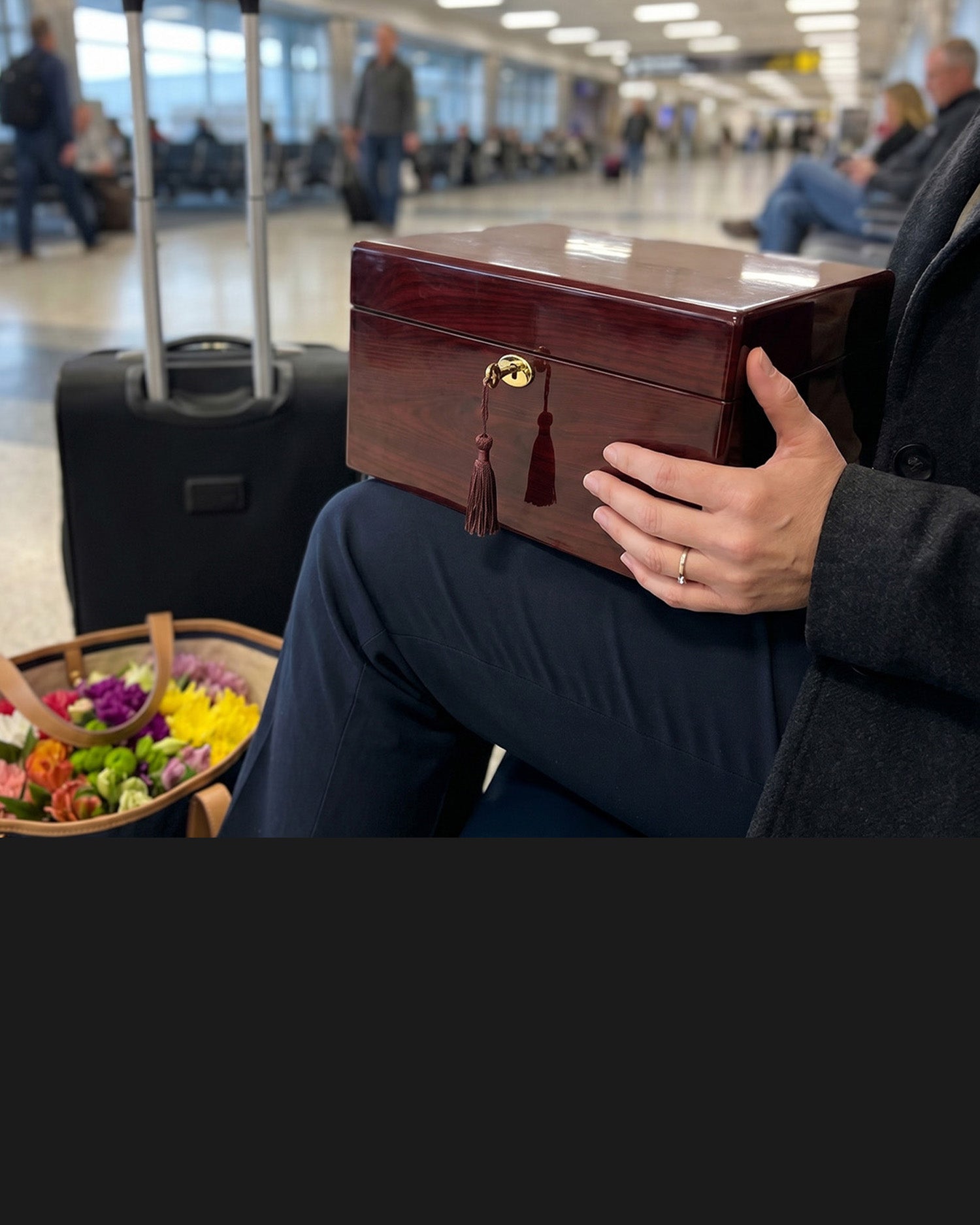
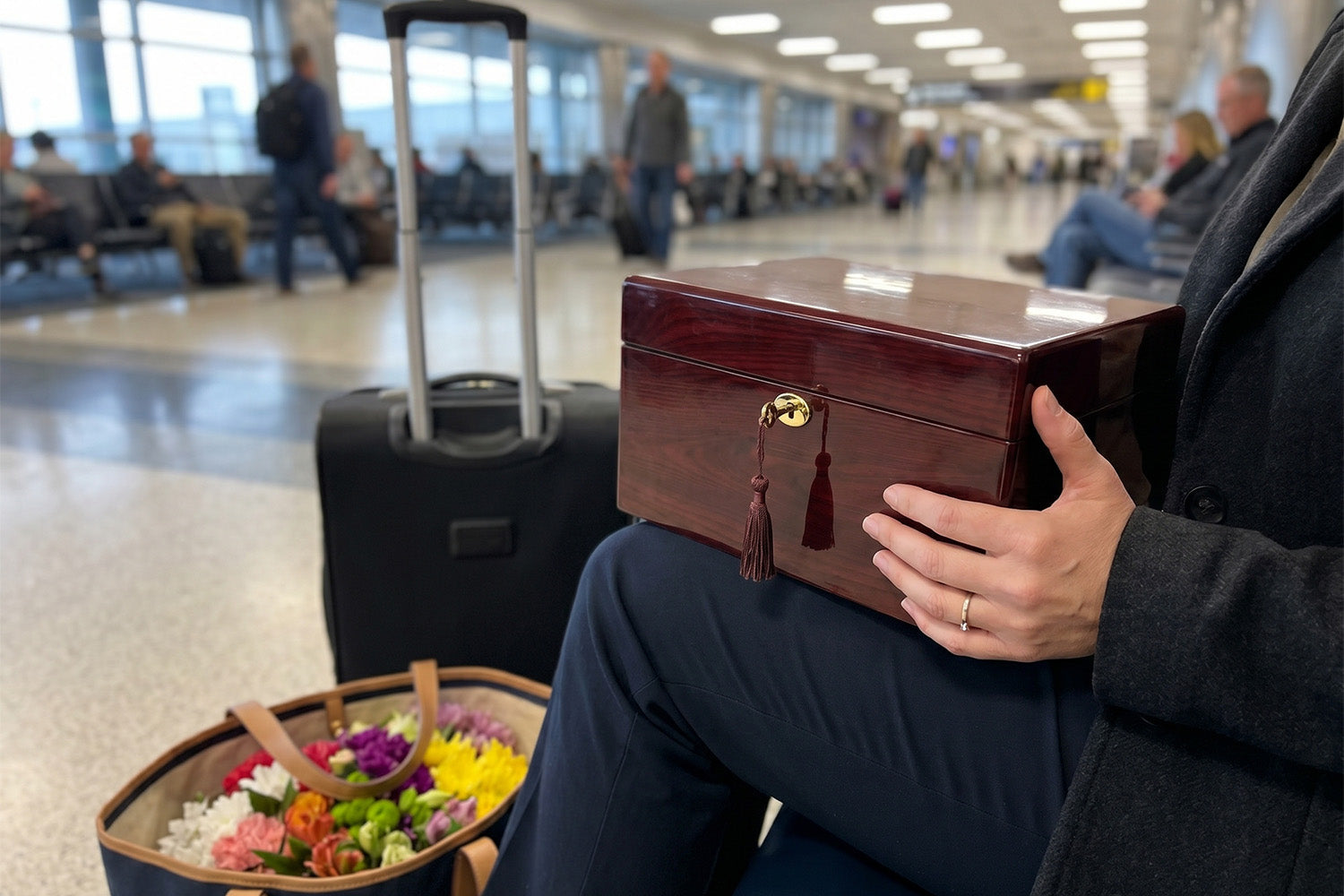
Many families I speak with do not plan to fly with cremated remains until they have to. A memorial in another city. A scattering ceremony at a meaningful place. A loved one being brought home.
And then the question arrives, usually with a little anxiety behind it.
"Can I actually bring an urn through TSA?"
Yes. TSA currently allows cremated remains in both carry-on and checked baggage, but the container must pass X-ray screening. If TSA cannot clearly screen the urn, it may not be allowed through the checkpoint. That one detail shapes almost everything else, from the urn material you choose to how you pack your bag.
I have seen families feel more nervous about airport security than the flight itself. That makes sense. You are carrying someone you love, and you do not want to be surprised at the checkpoint. This guide walks through what TSA says, what to bring, how to pack, and how to choose a travel-friendly urn with less stress.
Jump to a section
- 1. Can you bring cremated remains through TSA?
- 2. The most important TSA rule: the urn must pass X-ray screening
- 3. Carry-on vs. checked baggage: which is better?
- 4. What documents should you bring?
- 5. How to pack an urn for air travel
- 6. Keepsake urns and memorial jewelry
- 7. Can you ship cremated remains instead?
- 8. Quick TSA checklist for traveling with cremated remains
- 9. Final thoughts
- 10. Frequently asked questions
1. Can you bring cremated remains through TSA?
Yes, you can bring cremated remains through TSA security, as long as the container can be screened. TSA currently lists cremated remains as allowed in carry-on bags and checked bags, with special instructions. The final decision at the checkpoint rests with the TSA officer.
That does not mean every urn is equally easy to travel with. A beautiful urn made from dense metal, stone, marble, or thick ceramic may be meaningful at home, but it can be difficult for an X-ray machine to screen clearly. If TSA cannot determine what is inside, the container may not be allowed through.
The safest way to think about this is simple: TSA does not approve the memory, the ceremony, or the person you are carrying. TSA screens the container. If the container gives a clear image, the process is usually much smoother.
That is why the material of the urn matters so much. A well-crafted urn can still be beautiful enough for home and practical enough for travel, if it is made from a lighter material that screens well.
Rules can change, and airline policies can be stricter than TSA rules. Before you fly, check TSA.gov, then contact your airline directly.
2. The most important TSA rule: the urn must pass X-ray screening
The most important TSA cremated remains rule is that the urn or container must pass X-ray screening. TSA needs to clearly determine what is inside the container without opening it.
This is where many families get caught off guard. They choose a permanent urn first, then later realize it may not be the best travel urn. I once heard from a family who had chosen a beautiful metal urn for home display, only to worry the night before the flight that it would not screen clearly. That is the kind of stress you can avoid with a little planning.
Out of respect for the deceased, TSA officers will not open a crematory container, even if you ask them to. That is meant to protect dignity, but it also means the container has to do its job at the X-ray machine.
An X-ray friendly urn is not an official TSA certification. It simply means the material is more likely to allow TSA officers to see clearly enough during screening. Wood and plastic are the materials TSA specifically recommends as lighter-weight options for travel.
2.1 Which urn materials are TSA-friendly?
For air travel, lighter-weight materials are generally the better choice. A wooden urn is often a practical option because wood is one of the lighter materials TSA recommends for screening. Plastic temporary containers may also screen well, which is why funeral homes sometimes provide them for transportation.
Dense metal, stone, marble, and some ceramic urns can be harder to screen because they may create an opaque image. If the X-ray image is not clear, TSA officers may not be able to allow the urn through the checkpoint.
This is where Howard Miller Memorial’s wooden urns can make practical sense for the right family. They are designed as dignified home memorials, but wood is also one of the materials TSA recommends for air travel. That does not mean any specific product is TSA-approved, but it does mean the material itself is a sensible place to start.
If you already own a dense urn you love, consider traveling with the cremated remains in a lighter temporary container, then placing them in the permanent memorial urn after arrival. Ask your funeral director to help with this before the trip.

3. Carry-on vs. checked baggage: which is better?
TSA currently allows cremated remains in carry-on and checked baggage, but carry-on is usually the better practical choice for most families. With an urn carry-on, the cremated remains stay with you, and you can answer questions if additional screening is needed.
Checked baggage creates two concerns. First, some airlines do not allow cremated remains in checked bags, so you must confirm your airline’s policy. Second, checked bags can be delayed, damaged, or misplaced. For many families, that risk is not worth taking.
I usually suggest thinking about your comfort level. If you would be distressed if the bag did not arrive when you did, keep the urn with you in your carry-on whenever possible.
| Travel method | Pros | Cons | Key requirement to confirm first |
|---|---|---|---|
| Carry-on bag | The urn stays with you, and you can speak with TSA if needed. | The container must pass checkpoint X-ray screening. | Confirm the urn material is likely to screen clearly. |
| Checked baggage | TSA currently lists checked bags as allowed with special instructions. | Some airlines restrict it, and checked bags can be delayed or damaged. | Confirm your airline allows cremated remains in checked baggage. |
| Shipped via USPS | Useful when coordinating across states or sending remains to family. | Requires USPS cremated remains packaging and Priority Mail Express service. | Verify current USPS rules, packaging, and destination eligibility. |
3.1 Questions to ask your airline before you fly
Airline rules can vary, and they can be stricter than TSA rules. Before you book, or at least before you leave for the airport, contact the airline directly and ask clear questions.
- Does your airline allow cremated remains in carry-on baggage?
- Does your airline allow cremated remains in checked baggage?
- What documentation does your airline require or recommend?
- Are there container restrictions, labeling requirements, or advance notice requirements?
- Does the urn count as a carry-on item or personal item?
Write down the answer or save the airline’s policy page on your phone. If you are traveling with another family member, make sure they know where the documents and urn are packed.
4. What documents should you bring?
TSA’s main concern is screening the container, but documentation can still make the day smoother. Airlines, funeral homes, destination countries, and local authorities may have their own requirements, especially for international travel with cremated remains.
Bring paper copies. Digital copies are helpful, but paper is easier to hand to an airline agent, funeral director, customs officer, or consulate representative if someone asks.
4.1 Domestic travel
For domestic travel within the United States, I would bring at minimum a certified copy of the death certificate and the cremation certificate or cremation permit. If your funeral home provides a letter identifying the cremated remains, keep that with the same packet.
Keep the documents in the same carry-on as the urn, but not buried under clothes. A simple folder or document sleeve makes it easier to find them when your hands are already full.

Families often ask whether they need to announce what they are carrying. You do not need to make a scene. A quiet sentence to the officer, such as “I am traveling with cremated remains,” can provide context and help the screening feel more respectful.
If you feel nervous, write your checklist on a note and keep it with the documents. On a hard travel day, you should not have to rely on memory.
4.2 International travel
International travel is more complicated because every destination country can set its own rules. Depending on where you are going, you may need a death certificate, cremation certificate, transit permit, consular certificate, apostille, certified translation, or other documentation.
Before you travel, contact the destination country’s embassy or consulate. You may also need to check with U.S. Customs and Border Protection, the U.S. Department of State, your airline, and any transit countries on your route.
Do not assume that a rule for one country applies to another. If you are flying with ashes internationally, verify the requirements before you buy the ticket, especially if the trip involves a scattering ceremony, burial, or transfer to another family member.
5. How to pack an urn for air travel
Good packing is not complicated. It is about making the urn easy to screen, protected from damage, and easy for you to access if needed.
- Choose a lighter-weight, X-ray friendly urn or temporary container when possible.
- Make sure the container is securely closed before you leave home.
- Place the container in a protective pouch, soft cloth, or padded section of your carry-on.
- Keep death and cremation documents in the same carry-on bag.
- Do not bury the urn under several layers of clothing or electronics.
- Arrive early so additional screening does not make you feel rushed.
- Tell TSA calmly that you are carrying cremated remains if the bag is pulled for screening.
If you are using a temporary container, ask the funeral home whether it is securely sealed and suitable for travel. If you are using a permanent memorial urn, check the material first and confirm that it is likely to screen clearly.
Try not to overpack the bag. The less clutter around the urn, the easier the screening process tends to feel.
6. Keepsake urns and memorial jewelry
Keepsake urns and memorial jewelry that contain cremated remains still need to go through screening. The same basic idea applies: TSA must be able to screen the item clearly, and the container should be travel-friendly.
A keepsake urn can be a thoughtful option if your family wants to travel with a small portion of the ashes while the main cremation urn stays at home. I have seen this help families who are flying to scatter ashes in a meaningful place but still want a portion preserved in a home memorial afterward.
If ashes will be divided before travel, ask the funeral home to place each portion in a secure, labeled, travel-friendly container. That is easier than trying to sort it out yourself the night before a flight.
For families traveling to a destination for scattering ashes, a scattering tube may be more practical than a heavy urn. It is designed for the ceremony itself and can make the moment feel less awkward.
If your family plans to keep the main memorial at home, Howard Miller Memorial’s display-focused urns can still be part of the journey. You might travel with a small portion, then keep the primary memorial urn in a permanent place at home.
7. Can you ship cremated remains instead?
Yes, shipping can be an alternative to flying with cremated remains, but the rules are specific. USPS currently states that cremated remains must be shipped using Priority Mail Express cremated remains packaging. USPS Publication 139 gives current packaging instructions.
Shipping may make sense when family members live in different states, when a funeral home is coordinating delivery, or when air travel feels too stressful. It may also help when the traveler has a tight connection or is going to a destination with complex entry requirements.
Before shipping, verify the current rules directly with USPS.com or your local Post Office. For international shipping, confirm that the destination country accepts cremated remains and that Priority Mail Express International is available to that country.
The container must be sift-proof, which means loose powder cannot leak out. USPS also recommends cushioning the inner container so it does not shift during transit.
8. Quick TSA checklist for traveling with cremated remains
Use this checklist before you leave for the airport.
- Check TSA.gov for the current TSA cremated remains policy.
- Choose a lighter-weight, X-ray friendly urn when possible.
- Avoid dense metal, stone, marble, or ceramic containers for checkpoint travel unless you have confirmed your plan.
- Keep the cremated remains in your carry-on bag when possible.
- Confirm your airline’s urn carry-on and checked baggage policy.
- Bring a death certificate and cremation certificate or cremation permit.
- For international travel, contact the destination country’s embassy or consulate.
- Pack the urn securely but make it easy to access.
- Arrive early in case additional screening is needed.
- Tell TSA calmly that you are traveling with cremated remains if needed.
- Do not expect TSA to open the urn. TSA currently says officers will not open the container, even if requested.
- Verify REAL ID requirements with TSA before travel.

The goal is not to make travel feel formal or cold. The goal is to remove as many surprises as possible. When you know the urn can be screened, your documents are together, and your airline policy is confirmed, the day usually feels more manageable.
You are allowed to move carefully. You are allowed to ask questions. You are allowed to protect the dignity of the person you are carrying.
9. Final thoughts
Traveling with cremated remains can feel intimidating, but it is manageable with the right preparation. Start with TSA’s current rules, choose a container that can pass X-ray screening, confirm your airline’s policy, and keep your documents close.
A good urn can serve more than one purpose. It can be beautiful enough to honor someone at home and practical enough to travel with, if the material is right. Wooden urns are a natural place to look because TSA recommends lighter-weight materials such as wood or plastic for screening.
Howard Miller Memorial’s role is not to promise that any specific urn is TSA-approved. No brand should tell you that. The more honest point is that a thoughtfully chosen wooden urn, a lightweight keepsake, or a travel-friendly scattering tube can help the trip feel a little less uncertain.
And on a day when you are carrying someone you love, less uncertainty matters.
10. Frequently asked questions
10.1 Can you bring cremated remains on a plane?
Yes, TSA currently allows cremated remains on a plane in carry-on and checked baggage, with special instructions. The container must be able to pass X-ray screening. Some airlines may have additional restrictions, especially for checked bags, so confirm your airline’s policy before travel.
10.2 Will TSA open my urn at the airport?
No. TSA currently says officers will not open a crematory container, even if the passenger asks them to. Because TSA will not open the urn, the container must be clear enough on X-ray for officers to screen it properly at the checkpoint.
10.3 What is the best urn material for air travel?
TSA recommends lighter-weight materials such as wood or plastic for cremated remains containers taken through screening. Wood is often a good choice because it can be dignified for home display while still being more X-ray friendly than dense metal, stone, marble, or some ceramics.
10.4 Can you put cremated remains in a checked bag?
TSA currently lists cremated remains as allowed in checked baggage with special instructions, but some airlines do not allow them in checked bags. Many families prefer carry-on because the urn stays with them and is less exposed to the risk of loss, delay, or damage.
10.5 What documents do I need to fly with cremated remains?
For domestic travel, bring a death certificate and cremation certificate or cremation permit. A funeral home letter can also be helpful. TSA focuses on screening the container, but airlines or other authorities may request documentation, so keep paper copies with the urn in your carry-on.
10.6 Can you travel internationally with cremated remains?
Yes, but international travel with cremated remains requires extra preparation. Requirements vary by destination country and may include consular documents, apostilles, transit permits, certified translations, or customs forms. Contact the destination country’s embassy or consulate, your airline, and relevant customs authorities before departure.
10.7 Can you ship cremated remains instead of flying with them?
Yes, shipping cremated remains USPS may be an option. USPS currently requires Priority Mail Express cremated remains packaging and provides instructions in Publication 139. For international shipping, verify that the destination country accepts cremated remains and that the required USPS service is available.
10.8 Can you bring a keepsake urn or memorial jewelry through TSA?
Yes, a keepsake urn or memorial jewelry containing cremated remains can go through TSA screening, but it must still be screenable. Choose lighter materials when possible, keep documentation nearby, and ask the funeral home to place divided ashes in secure, labeled containers before travel.


Leave a comment
All comments are moderated before being published.
This site is protected by hCaptcha and the hCaptcha Privacy Policy and Terms of Service apply.